Loading article

Cookie preferences
We use strictly necessary storage for site operation and optional categories for experience, measurement, and marketing. Choose what Gelectric can use, and update it any time from Cookie Settings in the footer.
Cookie preferences
We use strictly necessary storage for site operation and optional categories for experience, measurement, and marketing. Choose what Gelectric can use, and update it any time from Cookie Settings in the footer.
Gelectric Editorial Team

The maritime industry is a vital part in the global economy, responsible for transporting over 90% of the world's trade. However, it also faces significant challenges in terms of fuel efficiency and environmental impact. Rising fuel costs and stricter emission regulations are putting pressure on ship owners and operators to find innovative solutions.
Gelectric.io is a company at the forefront of this fight, offering a suite of IoT-driven solutions that empower maritime players to optimize fuel consumption and reduce emissions. This article will delve into the challenges faced by the industry and explore how Gelectric's condition monitoring and electrical energy monitoring systems, equipped with real-time data analysis, can provide a powerful path towards a more sustainable future.
The Challenge: Rising Costs and Stringent Regulations
Fuel costs represent a major operational expense for ship owners. Price fluctuations in the global oil market can significantly impact profitability. Furthermore, the International Maritime Organization (IMO) has implemented increasingly stringent regulations to curb emissions of greenhouse gases (GHGs) and pollutants like sulfur oxides (SOx) and nitrogen oxides (NOx). These regulations, such as the Energy Efficiency Existing Ship Index (EEXI) and upcoming Carbon Intensity Rating (CII), are pushing the industry to adopt new technologies and operational practices that promote fuel efficiency and emission reduction.
The Gelectric Solution: Real-Time Insights for Smarter Decisions
Gelectric's condition monitoring and electrical energy monitoring systems provide ship owners and operators with real-time data and insights that can be harnessed to optimize fuel consumption and reduce emissions. These systems work by installing sensors throughout a vessel to collect critical data on various aspects of its operation.
Receive our monthly maritime intelligence report directly in your inbox.
Expand your knowledge with these recent publications.

When the International Maritime Organization (IMO) introduced the Energy Efficiency Existing Ship Index (EEXI), shipowners faced a strict mandate: establish a technical design benchmark to ensure existing vessels meet carbon intensity...
The true power of Gelectric's systems lies in their ability to collect and analyze real-time data from various sources onboard a vessel. This data is then fed into advanced analytics platforms that use machine learning algorithms to identify patterns and trends. These insights can be used to:
By implementing Gelectric's real-time monitoring solutions, ship owners and operators can achieve significant environmental and economic benefits:
The maritime industry has a critical role to play in the global economy, but it also needs to embrace sustainable practices. Gelectric.io is leading the way with innovative IoT-driven solutions that empower ship owners and operators to optimize fuel consumption and reduce emissions. By leveraging real-time data analysis, Gelectric's systems provide valuable insights that can help navigate the challenges of rising fuel costs and stricter regulations. By adopting these solutions, the maritime industry can move towards a more sustainable future, ensuring cleaner oceans and a healthier planet.
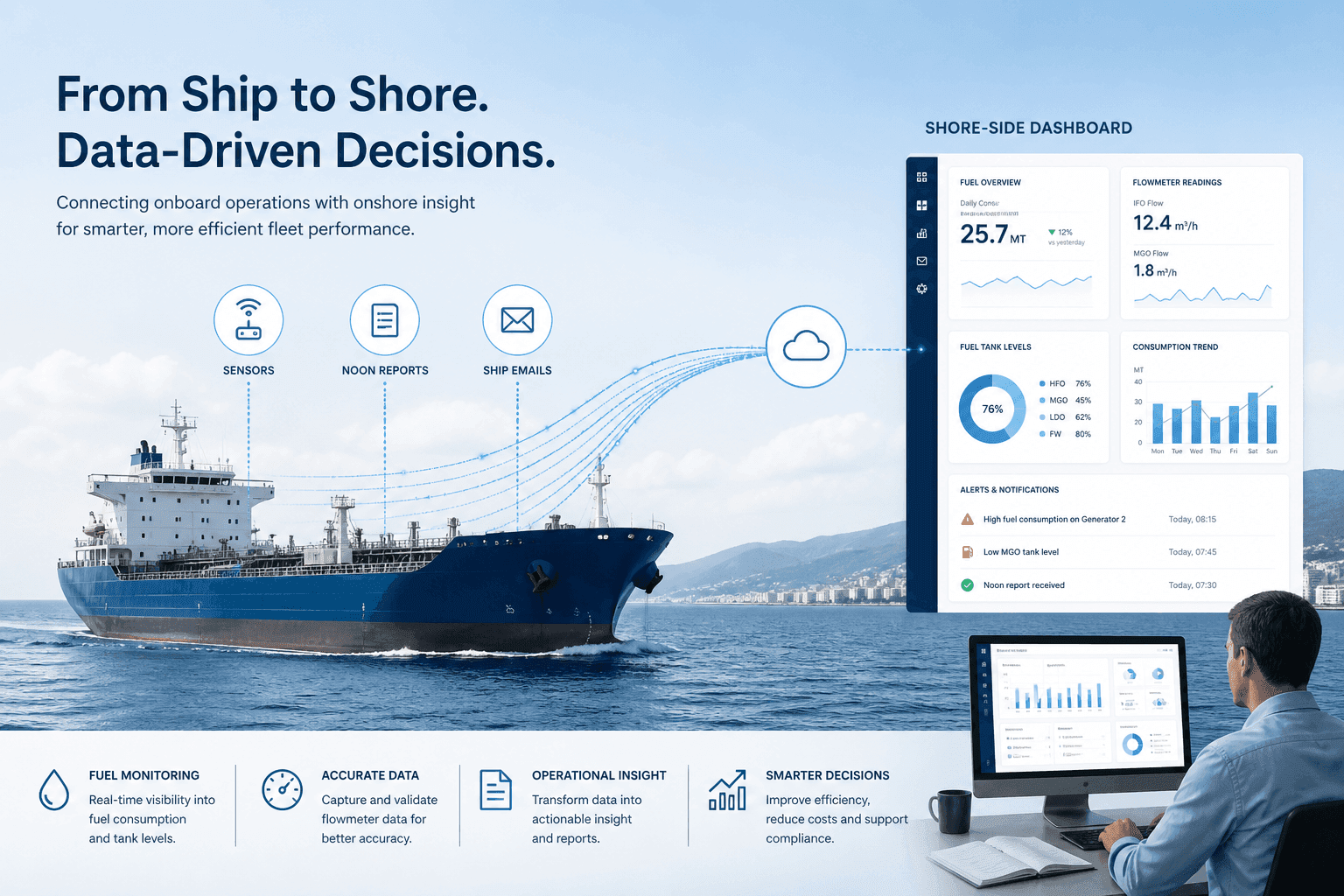
In many fleets, digital flowmeters are already installed on board. But in practice, the data is often still checked locally on the vessel, used only for limited reporting purposes, or reviewed after the fact. As EU MRV requirements continue...

Meeting regulatory demands in the maritime industry is no small feat. As shipowners and fleet managers, you face increasing pressure to comply with environmental standards while maintaining operational efficiency. The EU Monitoring,...